
Forestry governance: What you can model – and what you can’t
Kaingaroa Tipu is modelling its forest in extraordinary detail. Chair Jon Hartley says some of the hardest risks are beyond its control.
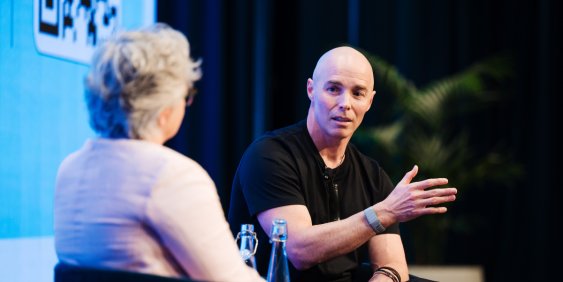
Simon Curran says leaders need to get on the tools, create permission to experiment and turn AI change into a movement, not a mandate.
Rokt began its AI push without a finished playbook, but with a chief executive ready to move.
“In January of last year, this playbook did not exist because we didn’t know how to do it,” Simon Curran told the IoD Governing AI Forum. “And the honest answer is we are still working it out.”
Curran is chief development and culture officer at Rokt, a New York-based ecommerce technology company that works with large consumer businesses. At the time, Rokt had about 860 people and close to US$1 billion in revenue.
Its founder believed AI would be “a tectonic change like we’ve never seen before”, but the people in the organisation were already stretched.
The chief executive’s early position was that the company needed to take a ‘risk-on’ posture to this change. Anything that did not breach the company’s risk protocols could be tried. Curran says that gave people permission to act without pretending the organisation knew exactly where the work would land.
AI felt more personal than earlier periods of change. During Covid-19, Curran says, the predominant question in most companies was whether everyone would get through it. With AI, the question became: “Am I capable? Will I make this? And if you make it, does that mean I’m not going to make it?”
That meant the change could not feel like a technology directive being pushed down from above.
“This needed to feel like it was a movement, not a mandate.”
The company studied how movements begin. It looked at religious, political and social movements and saw three beats: incite, ignite, then explode. When a movement explodes, Curran says, “there is no sense of we’re going back to where it was”. That became the shape of the first chapter.
Rokt’s first step was to agree on an audacious goal with a vivid description – something every person in the business could relate to participate in. “We framed our ambition as moving at five times our speed. That felt impossible from where we started, which meant it was right.”
The next step was to create a proof point for what was possible. It needed to be a real source of friction between us and the five-times goal. Recruitment was consuming too much leadership time. From the decision to hire through to onboarding, the process was taking about 60 days. The company set a simple challenge: to halve it.
The team chosen to do the work was not the obvious one. It was led by a non-engineer and made up of people who had not owned hiring before. Curran calls that “intelligent naivety”: “You’re bright, but you’re not stuck in the past because you don’t know how to do it anyway.”
Within 30 days, the team had built a workflow the company still uses. That mattered because it was not a strategy deck or a vendor promise. It was a working example from inside the business, built by people who could not be dismissed as “the AI people”.
The founder then called an all-hands meeting and told staff he wanted to talk about AI. Curran says the room leaned back as if it had heard the speech already. The founder told them they had not.
“I think 25% to 45% of our jobs will be displaced within six months. Now, we’re still hiring. So our opportunity now is retrain and redeploy, but your role will not be the same again, including mine.”
Then he removed the excuse of time. Standing in front of a screen while code ran behind him, he told staff: “What that’s now doing is wiping every one of your internal recurring meetings. I’m deleting them all.”
People checked their phones and saw it had happened.
The ask was to rebuild calendars with a “minimum viable meeting” mindset. If a meeting had been weekly, try fortnightly. If it had been an hour, try half an hour. If everyone had been attending, send fewer people. The time went into training.
The early training did not ask people to redesign their jobs. Curran says many were still asking whether AI threatened them, so the company started with play: everyday prompts, life hacks, simple tasks. “Here’s a life hack. Here’s a picture of a fridge. What have you done?”
Hundreds of small interactions helped people learn before the work became more confronting.
The senior team was not allowed to outsource that learning. Curran’s phrase is: “Do, don’t delegate.”
Every month, senior leaders had to show what they had built themselves. Not what they had commissioned. Not what they had paid someone else to make. What they had built.
The company ran AI showcases where people stood up and showed what they had tried, including what had gone badly. It also stopped the company for a 24-hour hack, mixing engineers with lawyers and salespeople with finance.
Curran says, “we weren’t measuring productivity, we were measuring behaviour”.
The company also refused to let tool choice become the reason for delay. If a tool passed security protocols, people had access. Curran says the logic was direct: if it was not the toolset, and not the skillset, “the only thing that will hold you back is your mindset”.
The first internal phrase was that the organisation would move at “five times our speed”. Curran says, looking back, they may not have used that wording again.
People heard speed and tried to accelerate in their own lanes. That created effort, but not necessarily progress. Curran says the lesson became velocity: speed with direction.
“Go fast in different directions means we don’t go anywhere.”
That shift led to a harder realisation. The company had been changing how people worked but had not yet changed the organisation underneath it.
“We did not change the organisation for AI. We changed the organisation for speed and AI enabled that.”
Curran says the next constraint was structure. The company looked at different organisational models being tested by large technology companies: the mushroom, the hourglass, the elite bar at the top. Its own structure, he says, looked like “a bloated onion”.
The bet it placed was different. It called it the “talent factory”.
Forty percent of the organisation would be level one and two talent: early-career, AI native people who were not protecting an old professional identity. Forty percent would be player coaches. The remaining 20% would focus on “visioning, strategy, pace”.
Leadership changed with that structure. Curran says if a leader’s role was previously defined as leading people, “that is almost gone”. The new model is the player-coach: “You’re on the tools, you’re leading by example, you’re side by side, not up and down.”
“You’re not the sage. You’re the co-worker, sleeves rolled up.”
By January this year, the company had momentum, but Curran says the threat had become ordinary drift.
“Our greatest threat now is not geopolitical, it’s not the market volatility, it’s not the exchange rate. Our greatest threat is entropy. The law of physics, the reversion back to the ordinary.”
Leaders were given two tests. The first was the “no list”. They had to stand up and name the work they badly wanted to do but would not do because the company was already trying to do too much “concurrently rather than consecutively”.
The second was the “whiteboard test”. A leader had to show how three board metrics flowed to their part of the organisation and then to what the team was working on that week.
“If you can’t do that, you don’t know that. If you don’t know that, there’s no chance your team can do it.”
Curran says that is “not an AI skill”. It is “just good leadership”.
Continue the conversation on governing AI at the the IoD’s Leadership Conference, which brings together more than 500 directors and business leaders for two days of governance discussion and networking. It will be held at Tākina Convention and Events Centre, Te Whanganui-a-Tara, Wellington, on 3–4 September.
Local and international speakers will discuss governance and leadership issues affecting Aotearoa New Zealand and the wider world. Register here.