
Cutting through the noise: Cyber resilience in an AI-powered world
As AI changes cybersecurity, boards need to understand the risk without losing sight of the basics.
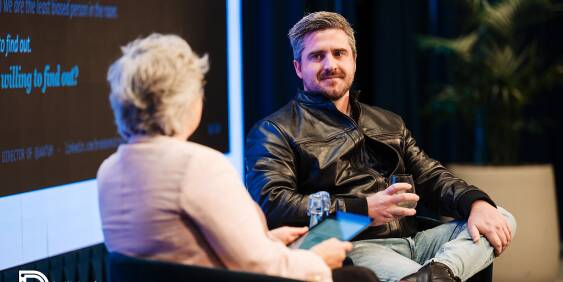
Brandon Hutcheson says AI can test the assumptions behind board decisions, without taking judgement away from directors.
“They gave artificial intelligence a seat at the table, not to answer their questions, but to question their answers.”
That was the boardroom experiment Brandon Hutcheson brought to the IoD’s AI Governance Forum: a European company, almost 200 years old, majority family-owned, with independent directors, two major decisions ahead and a younger generation family member wanting to bring AI into the room.
“They weren’t asking us to make the decisions for them,” Hutcheson said. “They wanted to know whether their decision-making process could be trusted.”
Hutcheson is Director of Quantum at HSO, where he leads advanced innovation in quantum strategy, AI and ethical technology deployment across global markets. Formerly co-founder of Aware Group, he helped build one of New Zealand’s best-known AI and data consultancies. He also serves as a council member of AI Forum New Zealand and speaks regularly on AI and ethics.
Hutcheson described the case study as an experiment that put human judgement and AI challenge side by side.
“It is an experiment, putting the two side by side, dropping an AI director into real decisions, and watching what surfaces.”

Hutcheson began with bias, saying that boardrooms are not immune from the assumptions directors bring into them.
“The problem is not that humans are biased,” he said. “The problem is that humans are biased and convinced that they are not.
“A boardroom is not the exception to this. It is the concentrated version, a room engineered to be full of confident, successful, decisive people. Bias does not get diluted at the top, it gets amplified.”
Hutcheson was equally clear that AI should not be treated as a clean, neutral referee. Human bias, he said, comes from self-interest, identity, emotion, reputation and survival. AI bias comes from the data it was fed, the way it was built, what it was trained on and the objectives it was given.
“One lies to save face,” he said. “The other repeats a lie that was never told it was a lie.”
In his view, human judgement and AI judgement both need supervision.
“This is not AI replacing the board, and it’s not the board ignoring AI. It’s two unreliable narrators that keep each other honest.”
The company in Hutcheson’s case study had two decisions ahead. The first was a €140 million proposal to automate its two biggest plants. The second was a once-in-a-generation review of €600 million in accumulated reserves.
Hutcheson said the board was making those calls inside a family company used to thinking across generations.
“A public company optimises for quarters and asks the shareholders who expect results now,” Hutcheson said. “A founding dynasty optimises for an inheritance.”
He described the AI’s role as decision support. “Note the word support. It briefs the decision. It doesn’t make it.”
The system was designed across a spectrum. At one end, AI worked as assurance – risk mitigation, compliance, governance and monitoring. At the other, it helped with advantage – knowledge discovery, strategic insight and decision support.
“Not one box pretends to be the board,” he said.
Hutcheson said the first six months focused on the discipline needed before AI could be useful in the boardroom.
The team captured data, connected feeds, enhanced archives and made board material traceable. Meetings were recorded. Notes were made accessible to the AI, including private notes. Numbers in board reports were traced back to their source, including who produced them and their history. Old minutes, reports and notes were classified.
“The AI watched, listened and read, and said absolutely nothing,” Hutcheson said.
Before AI took a seat at the table, the board was shown what its own records revealed.
“None of this needed artificial intelligence,” he said. “It needed traceability.”
That briefing was uncomfortable. Hutcheson said defer-and-pilot-first decisions over the previous decade had been right only two times out of 10, with an estimated €380 million left on the table. Two long-tenured executives had authored more than 80% of forward-looking numbers. The longer the tenure, the less the numbers were challenged.
On contested items, one director in three had written down doubts they did not say aloud. Revenue forecasts ran 12% high on average, while cost forecasts did not. Consensus formed quickly, especially when the most senior voice spoke first. Market assumptions still being cited as current in board papers were, on average, nine years old.
“The room went very quiet at that briefing,” Hutcheson said.
From month six, AI attended every board meeting. It still decided nothing, recommended nothing and ranked nothing. Hutcheson said it challenged what the room could see, live, and showed bias as a pattern rather than as a personal accusation.
It measured airtime, challenge rate and how quickly consensus formed. It showed results back to the board after each meeting, “always naming the pattern, not the person”.
“The restraint is the message,” Hutcheson said.
Behaviour changed because it became visible. The two loudest voices went from nearly two-thirds of airtime to well under half within four meetings. Challenge increased and became safer. Hutcheson said it stopped being “I disagree with you” and became “the pattern that disagrees with us”.
Two recommendations that might otherwise have gone through were sent back for evidence. Time to consensus on contested items roughly doubled. The gap between what directors wrote privately and what they said aloud almost disappeared.
“The dissent finally moved into the room,” he said.
The automation proposal exposed both what the system could see and what it could not.
Twenty years earlier, the company had tried an automation project and it had gone badly. Hutcheson said that one failure had been referenced 17 times in a decade of minutes.
“One bad memory, doing the work of the strategy,” he said.
The AI showed that no-go sentiment traced back to that failed project, rather than the current data. It also showed that the slowest option was risky because skilled trades were retiring faster than automation could replace them.
But the AI also missed something important: the social contract between the plant and the town – families, schools, local politics and the company’s role as the largest employer for a hundred miles. A third-generation director caught that and the rollout changed.
“The AI reframed the question, a human kept it humane.”
The board approved the full programme over four years rather than three, starting with the oldest plant first.
“The AI did not pick the speed,” Hutcheson said. “It stopped a 20-year-old memory from picking it.”
The capital reserves review revealed a different blind spot. The AI treated the €600 million reserve as money to optimise. The board saw something else: the reserve gave the family power to say no – to a takeover, outside investors or a bad year forcing a decision.
“They asked for money to optimise,” Hutcheson said. “The board saw the power to say no and kept it.”
Hutcheson said the value of the experiment was not speed or cost. “The point is the quality of the decision.”
The AI never made a single decision, he said. Every call was made by the same humans who would have made it anyway, but they had seen things that were previously hidden: their anchors, airtime and blind spots.
“This is the bar,” he said. “Not smarter, worthier.”
Hutcheson left directors with the question of whether they were willing to see what AI might reveal.
“You’re already sure you’re the clear-eyed one at your table,” he said. “Would you be willing to find out?”
Continue the conversation on governing AI at the the IoD’s Leadership Conference, which brings together more than 500 directors and business leaders for two days of governance discussion and networking. It will be held at Tākina Convention and Events Centre, Te Whanganui-a-Tara, Wellington, on 3–4 September.
Local and international speakers will discuss governance and leadership issues affecting Aotearoa New Zealand and the wider world. Register here.