
Forestry governance: What you can model – and what you can’t
Kaingaroa Tipu is modelling its forest in extraordinary detail. Chair Jon Hartley says some of the hardest risks are beyond its control.
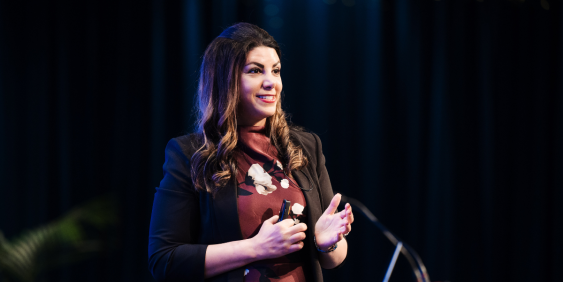
Mahsa McCauley MInstD says directors need to know when to use AI, when to question it and when human judgement should prevail.
“We are not right now facing an AI learning curve. What we are facing right now is an AI judgement curve.”
With that line, Dr Mahsa McCauley MInstD put human judgement at the centre of her Governing AI Forum address.
McCauley, Associate Professor at Auckland University of Technology (AUT) and chair of AI Forum New Zealand, opened with a personal reflection. As the mother of a nine-year-old daughter, she said she often thinks about the world her daughter is growing up into.
“I don’t see the future user of artificial intelligence,” she said. “I see a compassionate, curious human being.”
That future, she said, will require “wisdom and not just knowledge” and “resilience and not just response”.
McCauley’s work in artificial intelligence began well before the release of ChatGPT. Her PhD research was in natural language processing and statistical machine translation, at a time when she said many people did not know what natural language processing was.
The project she says she put her heart and soul into is now obsolete – not after 200 years, but little more than a decade after she completed her PhD.
“That is just to give you some context on how things are changing.”
McCauley said directors had already lived through major technological shifts, including the internet, but AI, in her view, is different.
“The internet gives us access to information, but artificial intelligence gives us power to act on this information instantly, intelligently,” she said.
“With the internet, people have to go and do the search, they need to do the decision-making, and they have to implement. But with AI, it can perceive, it can reason, and it can execute.”
She said speed was part of the story. ChatGPT reached 100 million users in two months, compared with much longer adoption periods for other digital platforms.
“It’s not a race. It’s a completely different type of competition, the one that the rules are being rewritten as you’re playing.”
McCauley also used AI-generated video examples to show how quickly capability is improving, from a glitchy 2023 video of actor Will Smith eating spaghetti to far smoother AI-generated video only a few years later.
“The rate of change is not slowing down,” she said. “Everything is just accelerating.”
McCauley said the public debate often confuses science with science fiction, moving too quickly to ideas of artificial superintelligence.
She set out three categories: artificial narrow intelligence, artificial general intelligence and artificial superintelligence. Generative AI, she said, still sits in the artificial narrow intelligence category.
“We are just scratching the surface of artificial general intelligence. We are not there yet.”
She also discussed the rise of AI agents, which she described as systems that do not only answer questions, but can pursue goals, plan and make decisions. However, she cautioned that many tools currently being labelled as agents are immature, or are existing systems rebranded under new language.
“A lot of those, they’ve been brand-washed,” she said.
Her point was not to chase every new label. Speed without direction, she said, is costly. “Speed without direction is an expensive case.”
McCauley said AI literacy is not only about learning how to use the tools. The harder question is when to use AI, when to trust it, how to identify bias and when to override it.
“The most important thing is to know when to trust your own expertise over machine confidence.”
She referred to research by Boston Consulting Group and Harvard University in which consultants used AI both within and outside its capability. When consultants used AI for tasks it was not well designed for, she said, they performed worse than those who did not use it.
“AI actually makes the skilled professionals less efficient when they use AI and they had lack of information about the capabilities of AI.”
Speaking as chair of AI Forum New Zealand, McCauley said New Zealand has both anxiety and opportunity in front of it.
Two-thirds of New Zealanders feel concerned or nervous about AI, she said, while 82% of organisations are adopting AI and reporting productivity gains.
“There is a gap between excitement and anxiety,” she said. “And I think the only way we can close this gap is through education.”
McCauley also referred to New Zealand’s AI strategy, saying it positions the country as a confident adopter of AI. She cited research from Microsoft and Accenture suggesting generative AI adoption could add $76 billion a year to the New Zealand economy by 2038, and that Kiwi workers could save an average of 275 hours a year.
She said AI Forum New Zealand’s productivity reporting showed the share of organisations reporting job losses due to AI had doubled, from 7% in March 2025 to 14% in August 2025.
“What it really shows us, it’s not about the headcount in your companies anymore, it’s about people with the skills.”
McCauley said there were several statistics directors should pay attention to. She cited the Board’s Pro-AI Governance Pulse 2026, saying 79% of leaders use AI at least weekly, but only 2% of boards have a formal AI governance framework in place.
Among organisations reporting high AI return on investment, she said, 63% have AI on every board agenda.
She also cited a global board governance survey showing only 26% of corporate boards discuss AI at every board meeting, and Deloitte data indicating 66% of boards still have limited to no knowledge of AI, down from 79% the previous year.
A World Economic Forum analysis, she said, found fewer than 1% of organisations have fully operational responsible AI practices despite rapid AI deployment.
McCauley then turned to societal risk, particularly AI bias.
“The most tender part of AI isn’t what AI does, it’s what it learns,” she said. “AI doesn’t think, it reflects.”
If biased material goes into an AI system, she said, bias can come back at speed and scale.
“Every mislabelled image, every sloppy annotation, every unchecked assumption, they can be amplified.”
McCauley said she and two PhD students are working on ways to mitigate bias in large language models. The work, she said, has proved more difficult than expected because “we are not dealing with not dealing with one bias. There’s so many biases”.
McCauley said high-stakes automated decisions are being enabled faster than social licence or safeguards.
She linked that concern to New Zealand, saying under-representation in the technology sector affects how systems are trained and who they serve.
“The under-representation of all of these diverse voices in the New Zealand sector can directly impact how these AI systems are going to be trained and who they are going to serve.”
McCauley closed by turning from risk to human value.
She said one risk not enough people are talking about is loneliness, particularly among young people. Technology, she said, is connecting systems while people become more disconnected.
She also reflected on what happens when AI makes polished output easier to produce.
“What I’m seeing these days is that perfection is getting cheaper. What is luxury is imperfection.”
After showing a clip on the Japanese idea of wabi-sabi and the value of things made by hand, she returned to the importance of human presence in work.
“Machines polish and humans leave fingerprints,” she said.
McCauley said the future of work is not solely for technology companies, AI vendors, employers or government to define. “It’s us – people who are using AI every day.”
Rather than asking only how AI will change workplaces, she said people should shift the question.
“How are we going to use AI to co-create this future, which is aligned with our values?”
That shift, she said, allows people to help create the future rather than passively accept it.
Continue the conversation on governing AI at the the IoD’s Leadership Conference, which brings together more than 500 directors and business leaders for two days of governance discussion and networking. It will be held at Tākina Convention and Events Centre, Te Whanganui-a-Tara, Wellington, on 3–4 September.
Local and international speakers will discuss governance and leadership issues affecting Aotearoa New Zealand and the wider world. Register here.