When climate risk hits the balance sheet
Climate risk is hitting assets, costs and finance. Boards need to bring that evidence into investment and strategy decisions.
Two early-career finance professionals share what sustainable finance has taught them about long-term value and board decisions.
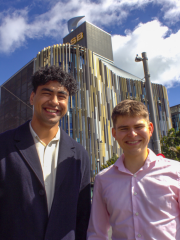
Henare Richards and D’Arcy Sanders
Henare Richards and D’Arcy Sanders came to sustainable finance with some doubts. Seeing the impact of real-world projects began to shift their thinking.
For Richards, now a Senior Analyst in Sustainable Finance at ASB, curiosity was the stronger pull. Finance, he realised, “quietly shapes almost everything”. Where money flows influences what gets built and, ultimately, the world that follows.
Sanders, a Future Me Graduate in ASB’s Sustainable Finance team, came to the area through an internship at consultancy firm Ekos, where working with climate-related disclosures gave him an early view of how differently businesses were responding to the same long-term challenges.
Seeing the transactions behind the terminology changed their minds.
“I came in a bit sceptical, half expecting it to be more talk than substance,” Richards says. “Instead, I found genuine projects with genuine outcomes.”
For both, exposure to transactions, including finance for renewable or clean energy and more efficient buildings, shifted sustainable finance from concept to something tangible. Sanders says working through the detail of what qualifies, how targets are set and how progress is measured also challenged any assumption that sustainable finance sits at the softer end of banking.
“It can sound quite conceptual, but in practice . . . it can get quite technical.”
There is also a generational dimension to how both think about risk.
Richards and Sanders have grown up with climate change as a constant backdrop, rather than a consideration that arrived midway through their careers.
“Climate has never been a new or separate issue,” Richards says. “It is just part of the world I have always known.”
He thinks about the immediate consequences of decisions and what they may mean for his children, their children and generations beyond them.
Sanders reaches the same point from a slightly different angle. From watching WALL-E as a child to seeing extreme weather events in the news, climate has always been part of the conversation for his generation. That can make the future feel uncertain, he says, but it also gives his generation a stake in shaping it.
“We will live with the consequences of the decisions being made now, but we also have the opportunity to help shape them.”
Working in sustainable finance has made those connections more concrete. Sanders points to physical climate risk and property. Flood exposure, for example, can affect an asset’s future value and attractiveness as an investment.
Richards similarly says the work has broadened his view of value. That includes whether a business is building something durable and resilient, and where the world around it is heading.
Both are cautious about assumptions made on behalf of younger generations, particularly the idea that they expect organisations to have all the answers.
“I trust an organisation far more when it is upfront about what it can and cannot prove, and admits the hard parts, than when everything sounds perfect,” Richards says.
He looks for evidence behind targets and commitments, and for organisations willing to make difficult choices when something does not stack up. “Being genuine shows up in the detail, not the marketing,” he says.
Sanders describes it as credibility over perfection. He does not expect organisations to have solved every problem, but wants to see genuine investment, transparency about the challenges and a willingness to improve.
“Often it takes a few organisations being prepared to move first before others follow.”
One advantage of being early in a career, both say, is not yet knowing all the reasons something supposedly cannot be done.
Richards sees value in asking “why” before assumptions are accepted as absolute truths. He says younger people may approach decisions by imagining the future they want and working backwards from there. When most of your working and adult life is still ahead, “the long term” feels real and relevant, not some distant abstract idea.
Sanders agrees that inexperience can sometimes be useful.
“When you're asking basic questions about why something works the way it does, you can uncover assumptions or norms that have simply built up over time.”
But neither sees fresh thinking as a substitute for experience.
Richards describes mentors as among the most important people in his career. Their guidance has influenced how he thinks and he hopes eventually to pass that on to others.
Sanders says experienced colleagues have taught him something different: that there is no single blueprint for a career. People make mistakes and change direction. There can be value in knowing you do not need to have the entire journey mapped out.
Ask where finance can make the biggest difference and both return to time.
Richards believes finance can give organisations the confidence and space to make decisions that may take years or even decades to deliver benefits.
“When lending and investment are built around the long term, they give businesses the patient, steady backing they need to plan with real confidence.”
For Sanders, finance helps businesses move from ambition to implementation. Strategies and targets may require significant investment, and finance can help businesses work through what can be funded and how today’s investment choices position them for the future.
Asked what question they would put around a board table, Richards goes directly to assumptions: “If the assumptions we are relying on today turn out to be wrong, where does that leave this business in 10 or 20 years, and what are we doing now to be resilient either way?”
Sanders’ question is equally direct: “Are we treating sustainability as something we have to comply with, or as something that can genuinely make this business stronger over the long term?”
Richards would like to reach the point where the word “sustainable” becomes redundant because climate and long-term value are simply part of good decision-making. Sanders similarly hopes resilience, sustainability and long-term value become integrated into business strategy rather than sitting alongside it.
“Stretch the time horizon,” Sanders says.