
The long view: what the next generation sees in sustainable finance
Two early-career finance professionals share what sustainable finance has taught them about long-term value and board decisions.
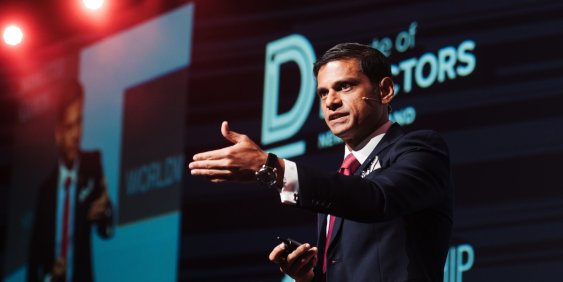
Governance adviser Shai Ganu warns that physical climate risk persists through political cycles as insurance becomes less certain.
“Physics does not lie,” Singapore-based governance adviser Shai Ganu told directors at the IoD Leadership Conference. “I’m not going to get into the politics or rhetoric of it, but the scientific evidence pointing to human influence on climate change is irrefutable,” he said, before turning to the physical effects of warming.
A chemical engineer by training, Ganu has also served on the World Economic Forum’s Climate Governance Committee of Experts, and is currently a global trustee on Chapter Zero Alliance – a by-directors-for-directors forum focused on the board’s role to drive climate action. He focused on the risks organisations may have to absorb as climatic conditions change.
Drawing on the World Economic Forum’s Global Risks Report, Ganu contrasted the pressures dominating the immediate outlook with those extending over the next decade. Geopolitical confrontation, misinformation and societal polarisation featured prominently in the short term, while five of the top 10 longer-term risks, including the top three, were climate-related, he said: extreme weather events, biodiversity loss and critical changes to Earth systems.
Those risks also interact. Ganu used involuntary migration as an example, pointing to the way extreme heat can affect health and quality of life and contribute to population movement. It was an illustration of a problem he returned to throughout his presentation – directors are accustomed to using past experience to anticipate what comes next, but interconnected risks do not necessarily develop in a straight line.
Ganu’s discussion of climate risk became particularly practical around insurance.
He described protection as part of the board’s stewardship role: identifying and quantifying risks, reducing them where possible and transferring some of the remaining exposure through insurance or other mechanisms. Climate change, he warned, may make that final step harder.
“One of the things that keeps me up at night … is the lack of insurability of climate-related risks,” he said, adding that he expected the problem to become more pronounced.
The comment raises a harder question than whether an organisation has adequate cover today. Insurance has traditionally allowed organisations to transfer part of the financial consequence of a physical event, but that assumption becomes less dependable if cover becomes unavailable for particular risks or locations.
Ganu’s framing was about protection: what can be mitigated, what can still be transferred and what the organisation may ultimately have to carry itself.
Ganu used thermodynamics to explain his assertion that “physics does not lie”, referring to the Clausius-Clapeyron relationship between temperature and the amount of moisture the atmosphere can hold.
For every one-degree rise in temperature, he said, the atmosphere’s capacity to hold water vapour rises by about 7 per cent. At around 1.5 degrees of warming, he put the increase at roughly 10 per cent.
“Ten per cent more water vapour means more rain and more extreme events of extreme precipitation,” he said. “Something we have to contend with.”
He also raised the future of the Amazon rainforest, warning that a shift towards savannah could turn a major carbon sink into a net source of emissions. He was concerned about systems that can behave differently once conditions move far enough from those on which previous experience is based.
That uncertainty challenges a familiar boardroom habit. Ganu said directors and executives are conditioned to examine the past to predict the future and to approach problems sequentially – identify, diagnose, solve. He questioned how reliable that approach remains where risks are interconnected and outcomes can be nonlinear.
Ganu’s phrase for preparing before conditions force the issue was “preset, not reset”.
“Traditional boards ask how quickly can we respond when the future arrives?” he said. “The future fluent board asks how early can we prepare before it arrives?”
Although he applied the idea more broadly than climate, it followed naturally from his discussion of physical risk. Decisions made before an exposure becomes acute leave more room than decisions made after the organisation is already dealing with the consequences.
Ganu also resisted separating environmental stewardship from commercial performance. In his formulation, protecting value and accounting for environmental conditions are part of the business. “We need to take a business lens,” he said.
“How does this drive value for our constituents?”