Why representation doesn’t translate to influence
Research has found women of colour face distinct barriers in leadership. What cultural and boardroom obstacles are at play?

Social conditioning still shapes how women’s voices are received. Understanding ‘hedging’ can help leaders speak with clarity and impact.
There is no question women are more visible in leadership roles than ever before – whether in politics, on boards or across diverse industries. But that doesn’t mean the territory is easier to navigate once they get there.
One of the challenges for women is how others perceive them when they are in positions of power. That is where language and communication styles come into play, shaped by deeply ingrained notions of 'femininity’ within Western gender expectations.

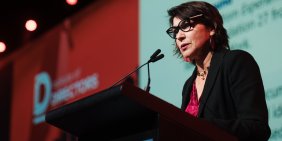
Dr Corinne Seals
For women, this creates limitations around how they should lead when they get to the top.
“We are socialised into expected ways of speaking, and others are socialised to expect that we speak in those ways . . . it operates at a subconscious level,” says Dr Corinne Seals Poukairangi, Associate Dean, Research, for the Faculty of Humanities and Social Sciences, and Associate Professor of Applied Linguistics at Te Herenga Waka - Victoria University of Wellington.
While it isn’t realistic to undo hundreds of years of social conditioning, there are tools women can use to assert their views and ensure they are heard without having to ‘man up’ in the boardroom.
Research reveals that women are interrupted more frequently in meetings because of “decades of social history and expectations” within a Western patriarchal society. The same is true when women speak 30% of the time and are perceived by men as ‘dominating.’
But before taking an overly forceful approach at your next board meeting, Dr Seals says it is possible to strike a balance so you are heard, understood – and importantly, remembered.
“When operating within the double-bind constraints of society, women need to assert authority and also be seen to do so in a socially acceptable manner for it to be understood and taken up by others. When women speak with less mitigation and more authority they are often seen as speaking outside their dictated role in society,” she says.
That means women are expected to bring a necessary softness to the table – carrying the mantle of nurturer and carer – and relatability, as opposed to taking a staunch and outspoken stance. But first, women need to recognise the language habits that may be getting in the way of progress. Seals refers to this as ‘hedging’.
“Words like ‘maybe’ or ‘possibly’ or ‘we might’ soften claims. If you present an idea with mitigators around it, it is not going to be remembered with the same strength as an idea presented without them,” she says.
Equally, when women assert ideas using ‘fact-based evidence’ without the any softeners, they are perceived as unfriendly – highlighting the double bind women face. Yet, overcoming these obstacles is not impossible. One leader was able to simultaneously project warmth, sincerity, relatability and authority was former prime minister Dame Jacinda Ardern.
“Part of what made Jacinda so effective was that she reduced her hedging but still presented a friendly, relatable tone. She spoke with authority, but in a way that came across as relatable – using plain language, shorter sentences and high-frequency vocabulary (for example, words which occur most frequently in written material, ‘and’, ‘the’, ‘as’ and it’).”
Seals says these have very little meaning on their own but contribute to the meaning of a sentence.
“She often started with ‘embodied symbolic capital’ (personal experience), but followed closely with institutional capital (facts, frameworks, her profession) . . . striking a balance that made her approachable yet authoritative,” says Seals.
Dame Jacinda's style of communicating also proved effective during times of crisis, where ‘hedging' helped her to build trust. For instance, in her Christchurch memorial speech following the mosque attacks, she acknowledged uncertainty and invited collaboration. This helped reduce backlash.
| Jacinda Ardern | Donald Trump | Angela Merkel |
|
"We will look at what can be done to stop this, but we need your help." |
"It's going to be tremendous, the best ever." |
"We believe these measures will help, but the situation remains unpredictable." |
|
Effects
|
Effects
|
Effects
|
In comparison with other global leaders, Donald Trump’s overly assertive claims – often aimed at appealing to the populace – have consequently eroded trust. Meanwhile, Angela Merkel uses ‘strategic hedging’ to manage uncertainty and build credibility with her audience.