The risk behind a strong CEO scorecard
Good numbers can leave culture, succession and conduct under-examined unless boards build scrutiny into the year.
2026 IoD Leadership Conference
What would a future director blame your board for missing? Four directors ask how boards can see vulnerability before harm occurs.
Jonathan Mason CFInstD has a test for board decisions: would a future director, looking at your photo on the wall, blame you for a problem no one saw coming decades ago?
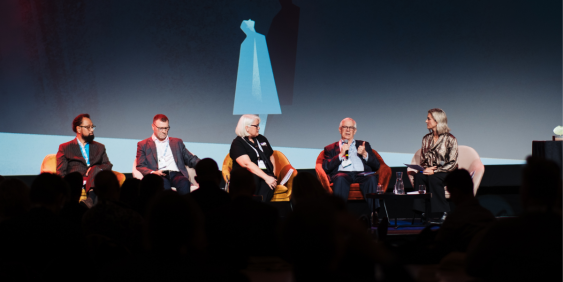
Mason was speaking at the IoD Leadership Conference in Wellington in a session called Governing for vulnerable customers: Lessons from governance failures, alongside Murray Harrington CFInstD, Michelle Urquhart MInstD and Vena Crawley MInstD, with Shirley McLeod CMInstD facilitating. The session examined the board’s role in protecting vulnerable customers and what governance failures can reveal about culture, customer outcomes and oversight.
At Dilworth School for Boys, where he is chair, Mason looks at the portraits on the wall – “the most distinguished directors” the school has had – and asks what today’s board might be missing that could look obvious, and damning, three decades from now.
He cited a New York Times report on research that found at least one in four former NFL players who died between 2016 and 2021 had CTE, a degenerative brain disease associated with repeated head impacts. Rugby, Mason said, presented a comparable concern.
Dilworth gives boys general warnings about sporting injuries, without addressing CTE specifically. “What are the risks now that could haunt your organisation in the future?”
Mason’s question comes from Dilworth’s history of sexual abuse and the board’s failure at the time to recognise its extent.
The independent inquiry found sexual abuse occurred at Dilworth from the mid-1950s until the end of 2005. Of the 171 former students who gave the inquiry information about sexual abuse, 126 reported being sexually abused at Dilworth. The inquiry said the true number was likely higher. The board of that era, Mason said, was “the commercial elite of Auckland business” – “all white men” – whose “school oversight was minimal”.
Summarising findings from the Cartwright report, Mason said Dilworth’s endowment returned 16% a year from 1990 to 2020, placing it in the top decile globally. He contrasted that financial performance with what he described as minimal oversight of the school. Spending time there, he said, “did not help to identify sexual abuse”.
Mason said sexual abuse at the school fell 90% after the school moved away from corporal punishment in the 1980s. Giving staff the power to physically punish boys, he said, had also given them “the ability to go into sex abuse much more easily”.
The panellists agreed that protecting vulnerable customers was a governance responsibility. For Harrington, a director of disability support provider IHC, it went to the organisation’s “licence to operate” and strategy. Crawley put it more bluntly: “Vulnerability is a solvency issue . . . wearing a customer service costume.”
Boards, Crawley argued, own three things management cannot: risk tolerance, assurance that reported experience matches frontline reality and accountability when something goes wrong.
“Regulators, media, shareholders . . . don’t go to the service desk, they come to the board.” Urquhart, chair of Scouts Aotearoa, pointed to obligations under the Children’s Act 2014 as part of the organisation’s child-protection responsibilities.
Harrington recalled how IHC responded to a bathing-related death by removing baths nationwide. The decision was made “with a lot of care”, but without consulting families, members, donors or the wider sector. The backlash was severe. “The board didn’t consult,” he said, describing “a very legal approach to a very complex issue” that failed to weigh wider considerations.
Urquhart said Scouts Aotearoa had been blind to what was happening within the organisation for much of its 120-year history. Its complaints system, she said, “actually protected the very people that were undertaking the behaviour we wanted to stop”.
Crawley’s review of public inquiries found boards rarely failed because of one bad actor. Aggregated reporting obscured individual experiences, incentives conflicted with care. Systems designed around a ‘majority culture’ customer also failed to serve every community equally.
Mason proposed exit interviews for every boy who leaves Dilworth, a statistically significant sample of graduates and departing staff. “I can’t guarantee” this would have exposed the abuse sooner, he said, “but I think it’s much more likely.” At Scouts, Urquhart said exit interviews must be designed so children – most of them under 10 – can engage with them. Boards also need to leave the boardroom and talk to people at the grassroots.
Crawley urged boards to stop treating “vulnerable customers” as a fixed category and identify the moments when any customer may become vulnerable. Cognitive decline or making an insurance claim “at your lowest” can alter what someone needs from an organisation. Few companies, she suggested, could answer a basic question: “Can your systems in your company identify vulnerable customers?”
Crawley questioned whether residents would criticise food or missed care during an organised site visit and called for “unstructured exposure”. Mason recommended listening to customer-service calls. Doing so at Westpac, he said, showed him how many customers had no buffer for even a $200 emergency and would need an overdraft.
Mason described a company that believed dropping distributors who were breaking the law would sacrifice 60% of its Taiwan business. The projected loss fell first to 30%, then 10%; replacement distributors ultimately grew the business by 20%. His conclusion was organisations can usually find a commercially sound way to do what is right.
Harrington said boards should consult carers, parents, whānau and the wider community when vulnerable people could not speak for themselves, to get “a really good read on what’s actually happening out there”.
Asked for one governance practice every board should adopt, Urquhart drew on a whakataukī about the footsteps laid down by ancestors creating the paving stones on which people stand today. In a 120-year-old organisation, she said, she is “just the custodian of the pathway” – and urged directors to start laying it rather than wait for someone else.
Crawley’s answer was direct and free. “Go back this quarter,” she said, “and ask your board what does the 1% of customers that we don’t hear from look like. And if that room goes quiet, we’ve got problems.”