Thirty-five years on, the CDC widens its lens
The governance fundamentals remain the same. At Waiwhetū Marae, participants brought whakapapa, tikanga and mokopuna into the room.

Aaron Hape MInstD reflects on governing for growth across philanthropic, cultural and iwi boards – and resisting retreat under pressure.
Not many people can say Queen Elizabeth II provided their introduction to governance – but that was the case for Aaron Hape MInstD.
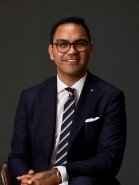 “I was a member of the advisory panel for the Queen’s Young Leaders Award programme for her Diamond Jubilee,” says Hape, whose governance roles today include chairing the Te Papa Foundation and serving on the boards of the Shakespeare Globe Centre New Zealand and the Iwi Development Trust for Ngāti Kahungunu ki Tāmaki nui-a-Rua.
“It was an incredible learning curve. Sir John Major chaired the panel and Queen Elizabeth II personally signed off the panel’s recommendations.”
Today, Hape is a senior public policy and governance leader with extensive experience driving transformative change across the public, commercial and philanthropic sectors.
He is a Fellow of the Royal Society of Arts and, in 2017, became the first person of Māori descent to be invested as a fellow of the Royal Commonwealth Society. He is also a member of the Institute of Directors’ 2025 Mentoring for Diversity programme.
With Te Papa undergoing a major restructure, governing for growth – one of the IoD’s Top 5 Issues facing directors in 2026 – resonates strongly for Hape.
“One of the hardest tests for directors during a growth phase, especially when the organisation is also under pressure, is resisting the instinct to retreat and focus on survival,” says Hape.
“Too often, boards slip into a compliance mindset and mistake that for stewardship. Compliance is the floor – not the ceiling.”
Hape says the experience of being a director on a philanthropic entity is quite different from traditional boards.
“I’ve served on commercial boards that drive the bottom line and, in a sense, we do too. But the biggest challenge is mindset.
“Twenty per cent of my time is spent working internally to change perceptions that private money is a bad thing. The remainder is spent developing internal and external relationships and navigating regulations and legislation that come with chairing an organisation that supports a public sector entity.
“As a foundation, we think philanthropy is not peripheral to growth but one of the key levers that makes growth possible.
“Public funding is provided as the baseline, but philanthropy enables us to strengthen, innovate and deliver projects that would otherwise sit on the shelf.
“The board has taken the view that growth is better than hitting pause and trying to restart later. We want to govern in a way that keeps growth alive. You can continue to grow during change, but you have to adapt.”
Hape says one of the biggest misconceptions around growth is that it has to mean doing more, faster.
“Governance for growth is also about building resilience and creating options, so the organisation has choices when conditions change.
“We are focused on building the endowment fund and diversifying the funding base, so Te Papa is less exposed to shocks and in a better position to seize the opportunities that come its way.
“Top of mind for me is the relationship between myself as chair of the foundation and the CEO of the organisation. I see that as the fulcrum of the whole organisation.
“We are very engaged and have clear roles, communication and trust. That allows us to have very honest conversations, move quickly and take considered risks.”
Hape says a rising new issue he sees in governance is donors and shareholders taking a far closer interest in operations.
“Increasingly, investors and shareholders want a say in how an organisation is run and what it is investing in. Often, they want to know that it isn’t in weapons, tobacco or extractive industries. That is a trend and boards will need to adapt to it.”
Serving on the board of the Shakespeare Globe Centre, which oversees the national programme of youth Shakespeare competitions and supports top performers to take the stage at London’s Globe Theatre, has provided a different perspective.
“It requires a different governance style from Te Papa. We take some cues from our parent group in London but have a great deal of autonomy.
“When I joined, the organisation was facing the loss of its government funding. It has been interesting to be part of the board as it has tackled the long-term sustainability strategy.
“The new chair, who was appointed around the same time, is very good at saying if things are not good. There have been a lot of tough conversations around what is working and not working and a lot of planning around sustainability and how to grow the operation.”
Hape says his own approach as a chair is also decisive.
“I allow ideas to have their place in the sun, but sometimes it’s better to give something a quick death and move on.
“My strengths are reminding people why they are there and where they fit into the plan, focusing people on what we are there to discuss and bringing disparate voices together so we’re all pushing in the right direction.”
Being appointed to his iwi development trust board has also been a different experience.
“I’m Māori but did not grow up with tikanga, so stepping into the Trust, which is responsible for strategic initiatives that drive economic and social growth within our iwi, I’m learning a lot about iwi governance.
“That’s an interesting journey. The board hasn’t quite developed that governance maturity yet to know when to lean in and when to step back. You need strong governance in the middle to engage consistently and be well informed but not constantly interfering.
“I have seen Māori boards that want to do everything under the sun with limited funds. They end up, despite good intent, trying to do too much and achieve too little.
“One of the biggest barriers I see to Māori business growth is a focus on quantity over quality. We need to take a step back and assess the long-term future.”