Warning signs sports boards should not ignore
Weak information flow, side conversations and repeated stakeholder concerns can point to trouble long before it becomes public.
Martin Snedden CNZM says recent disputes show how quickly relationships fracture and board judgement unravels in the heat of conflict.

Martin Snedden CNZM
Across New Zealand sport, a succession of public disputes, integrity issues and governance controversies has placed boards, chairs and chief executives under sustained scrutiny.
Cycling, gymnastics, rugby, netball, yachting and boxing have all been the subject of significant publicly reported concerns, independent reviews, integrity investigations or governance reform processes in recent years. Cricket, water polo and badminton have also faced organisational or governance-related challenges, although the circumstances, scale and responses have varied.
That scrutiny has also extended to the structure of the system itself. Reviews of Sport New Zealand and High Performance Sport New Zealand have examined governance and organisational arrangements, including questions about the relationship between policy advice, funding decisions and sector oversight.
Sport has always been volatile, says Martin Snedden CNZM, but the environment around that volatility has changed.
“There’s an inherent volatility in sport,” he says. “You’re not walking into something that’s going to be consistently smooth. You’re lucky if it is.”
Social media has made that volatility more disruptive and the reputational consequences more immediate. Directors and executives can find themselves publicly exposed in ways they may never have expected when they accepted the role.
“What I’m seeing now is that people just won’t blindly accept what comes their way,” says Snedden. “Chairs and CEOs are looking at it and questioning whether the effort and risk is worth it.”
Sport already has to compete for governance talent but many chairs and most board members are volunteers or are paid next to nothing. Snedden worries that the combination of little or no remuneration and greater public exposure will dissuade good people from becoming involved or encourage them to leave.
Snedden chairs Cycling New Zealand and is a former chair and CEO of New Zealand Cricket. He was first elected to the New Zealand Cricket board in 1990. His governance and leadership experience spans organisations including Rugby New Zealand 2011, the International Cricket Council and Women in Sport Aotearoa, as well as chief executive and not-for-profit governance roles in tourism and business events.
He also leads Sport NZ’s Sector Chairs Community of Practice, involving board chairs and other board members of more than 30 national sporting organisations and all 18 regional sports trusts. A feature of this governance community is the camaraderie and empathy between people dealing with similar pressures.
“Everyone knows they’re in the middle of a bit of a battlefield.”
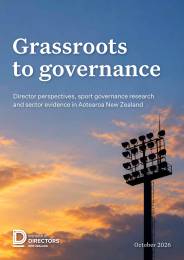
Interviewed as part of the Institute of Directors’ new research into sport governance in Aotearoa New Zealand, Grassroots to governance, Snedden described how his own thinking has changed.
“For a long time, I probably put more weight on structure. Now, I would rank emotional intelligence and relationship-building skills as being the highest-priority attributes needed by sport governors.”
Snedden points to Covid-19 as an example of sport responding differently under pressure.
Revenue disappeared, activity stopped and organisations were trying to work out whether they could survive. What stood out to him was the degree of collaboration and empathy across sport.
“People worked together in a way we’d talked about for years but never really achieved. It just happened.”
However, when organisations come under sustained stress, “the first thing that tends to go is relationships”, says Snedden.
Boards can begin “putting a shell around themselves”, talking mainly to one another and reinforcing their own thinking. The willingness to expose that thinking to other perspectives and test it properly can diminish.
“The more that happens, the worse it gets.”
He has also seen situations where key decisions are effectively predetermined by a chair and chief executive, or another small group, before the wider board has properly considered them. Board papers can then be shaped towards that outcome, with other relevant information downplayed or omitted.
“You can have very capable people sitting there and they don’t see it. They think they have good information and they are making the right call. Later on, they find out there were things they should have known.
“That’s not about how smart people are. It’s about how governance is being practised.”
Snedden says governance crises can catch board members off guard because they often find themselves dealing with situations they never expected when they joined a board.
“People often aren’t used to being in that position. That’s not what they signed up for. They thought they were signing up simply to help and support.”
A governance dispute can quickly become public, drawing media attention and social media commentary. Snedden says there is a real risk of individual board members, and sometimes entire boards, panicking under that pressure.
“If you’ve got quite clear processes and communication plans, then you can absorb the volatility. If you don’t have that and the leadership to absorb it, there’s a risk of panic reactions.”
He says experienced chairs and board members play a critical role in providing stability and guarding against panic reactions while organisations work through difficult situations.
Snedden was closely involved in developing New Zealand Cricket’s constitutional approach to board appointments and, more recently, New Zealand Football’s. In both cases, the approach was based on an independent, skills-based process. He remains convinced of the model and notes that versions of it have subsequently been adopted elsewhere in sport.
“I still think it’s the right model, but my thinking has evolved. Even the best structural models are still dependent on the quality of people. A really good structure can crumble very quickly in the absence of good leadership.”
When Snedden is involved in appointments now, functional skills remain important, but he gives more weight to cultural fit – emotional intelligence, behaviour and how people are likely to operate together.
“I see a board as a team. If the team dynamic isn’t right, the structure won’t save you.”
At Cycling New Zealand, half the board members are elected by member organisations. Snedden says elected board members can initially arrive believing they represent the group that appointed them. But his experience has been that they quickly come to understand their responsibility to the organisation they govern while still contributing the valuable knowledge and experience that comes from their connection with a particular part of the sport.
Through the Sector Chairs Community of Practice, Snedden meets many capable leaders who have achieved considerable success elsewhere. “Because you’ve been successful in the rest of your life, you can be fooled into thinking that’s enough for you to get by on governance. Many highly capable people arrive on a sport board with a limited understanding of governance.
“There’s a tendency in sport to think governance is something you just pick up. It isn’t. Governance is an art to be learned. Instinct will only get you a little bit of the way. You need a solid understanding of what good governance looks like and what it doesn’t look like.”
Snedden says good governance depends heavily on the chair’s governance experience and emotional intelligence, including their ability to establish a sound governance framework and to help the board and chief executive understand how best to operate within that framework.
He says it is vital that chairs, board members and chief executives undertake appropriate governance professional development. “There are still organisations operating at a pretty amateur level from a governance point of view. That’s just the reality.”
One improvement Snedden would like to see across sport is better preparation for and delivery of board meetings, including more tightly focused agendas and papers.
“If you get that right, the whole thing works better. Decisions are clearer, discussions are better and the CEO is better supported.”
Snedden’s view of the boundary between governance and management has evolved as well.
“There isn’t a fixed line. It moves depending on the organisation, the relevant workstream, the people involved and what’s going on at the time. You’ve got to work it out. It is often a negotiation between the board and CEO.”
That can be particularly important in smaller sporting organisations, where management teams do not have, and cannot be expected to have, the required capability and capacity. A smart chief executive will find the right way to draw productively on experience around the board table.
“You need to work hard to find the right solution because, if you get it wrong, you either have board members trying to get involved in operational matters or, at the other end of the spectrum, you get a CEO who shuts the board out.”
Looking back on his own time as a chief executive, he says he did not always make the best use of his boards.
“As a CEO, I was probably more interested in getting things through than I was in using the board properly. I didn’t understand and, most of the time, didn’t want to call on the experience around the board table. I just want the board to rubber-stamp my recommendations and then stay out of the way. It wasn’t until I sat on the other side of the table that I realised my approach to this was really dumb.”
“In most sports, you’ve got a federated structure with members who have their own interests,” says Snedden. “They’ll assert their rights and they’ve got the ability to remove boards.”
He points to recent events in cricket, rugby, netball, water polo and badminton when discussing the pressure members can exert.
Snedden says national bodies can lose sight of the fact they are membership organisations. Members have constitutional rights and, in some structures, the ultimate ability to remove the board.
The challenge is to connect with members in a way that allows them to be heard without undermining the board’s decision-making authority.
Federated structures bring member pressure. Integrity frameworks and dispute processes add another pressure.
Snedden acknowledges the value of making it easier for issues to be raised, but also points to the amount of time organisations can spend dealing with complaints and disputes.
“One of our biggest risks is that our sport organisations are at risk of being completely overrun by dispute resolution. There’s too much time spent on things that don’t necessarily warrant that level of attention.”
The question of how to deal with these pressures also feeds into the work of the Sector Chairs Community of Practice, where chairs can talk with others facing similar issues.
He describes much of the work as whanaungatanga – building relationships – and giving people comfort that others within our governance community are experiencing many of the same challenges.
Moving into a chair role can itself come as a shock, even to experienced board members.
Snedden says people who have been on boards for some time can underestimate how much work is involved in chairing well. The chair, like the chief executive, can find themselves caught between different groups – the board, management, members and other stakeholders.
The opportunity to talk openly with peers helps chairs understand that they are not dealing with those pressures alone.
Snedden’s thinking has also changed on board diversity.
In 2016, he was involved in New Zealand Cricket’s work to increase the number of women in governance across the cricket system.
At the time, he says there were only 11 women among roughly 220 board members at national and regional level. New Zealand Cricket made minimum female representation a condition of funding and later moved towards a 40% target.
Within three years, the number had risen to 83. Snedden says that New Zealand Cricket and their six major regional boards moved quickly to equal gender representation.
He had not originally been convinced about quotas, but “they can be very effective in breaking down barriers”.
Snedden also saw wider effects, including greater ethnic diversity and changes in boardroom dynamics.
He supports board rotation and broadly supports limits such as eight or nine years, while allowing for exceptional circumstances where some continuity may be needed.
“There’s value in bringing new people through, but you also need to retain experience. Getting that balance right matters.”
“Most people involved in sport are there because they care about it. That’s a good thing, but it doesn’t replace governance capability.”
Chairs carry demanding workloads. Chief executives can be caught between their boards, staff, members and other stakeholders. Board members can find themselves at the centre of disputes they never expected to become public.
Snedden continues to support strong appointment systems, clear governance frameworks and deliberate board composition.
“If the environment is going to stay this tough, then governance must keep improving.
“Structure will only take you so far. It’s the people and how they behave that determine whether it works or not.”
Grassroots to governance
Grassroots to governance: Director perspectives, sport governance research and sector evidence in Aotearoa New Zealand draws on interviews with 19 chairs, directors, executives and sector leaders, alongside sport governance research, sector reviews and club-level evidence. It examines the pressures facing sport boards and the practices that can strengthen governance capability.
Free webinar
Join Martin Snedden CNZM, Alan Isaac CNZM, DistFInstD, Professor Sarah Leberman MNZM, CMInstD and Judene Edgar MNZM, CMInstD for a practical discussion on where sport governance is being tested and how boards can respond.
12.30pm–1.30pm, 12 November 2026 | Online