Thirty-five years on, the CDC widens its lens
The governance fundamentals remain the same. At Waiwhetū Marae, participants brought whakapapa, tikanga and mokopuna into the room.

Sharon Shea MNZM, MInstD sees responsible AI and digital innovation as essential tools for boards seeking better, more equitable outcomes.
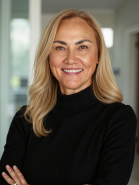
Sharon Shea MNZM, MInstD
Māori leader, director and company owner Sharon Shea MNZM, MInstD is passionate about the potential of innovative digital tools to support wellbeing and improve equity. As a governance leader with more than 25 years’ experience, she’s increasingly interested in how boards can embrace responsible AI and digital innovation to better serve communities.
It is this drive to improve outcomes that draws her to ‘AI agents of change’ – one of the Institute of Directors’ Top 5 issues for directors in 2026.
“I love the power of digital innovation to disrupt systems and create opportunities to streamline workflows,” says Shea (Ngāti Ranginui, Ngāti Hauā, Ngāti Hine, Ngāti Hako). “It enables people to spend more time leveraging their skills and expertise to solve problems.
“I see the power of AI to support communities to access quality, integrated services, and I want to explore the preventive aspect to improve health outcomes.”
Improving outcomes for New Zealanders – particularly those facing intergenerational, health or disability inequities – has long driven Shea’s governance and business work.
Her governance career has included three terms on the Northland DHB, becoming the first Māori chair of the Bay of Plenty DHB and serving concurrently on the boards of Health New Zealand/Te Whatu Ora and the Māori Health Authority/Te Aka Whai Ora, where she became co-chair.
The journey began when Shea returned to New Zealand with a Master’s in Comparative Social Policy (with distinction) from Oxford University. She already had a Bachelor of Laws and a Bachelor of Arts and had worked as a lawyer and in senior management in Māori health improvement.
Today, as director and principal consultant of Shea Pita Associates, she focuses on strategy, outcomes framework development, data design and use, project and change management, and systems and service design.
“My first governance role was for my marae’s trust,” she says. “That often happens with young Māori people, especially if you are going through tertiary education. You are called upon because you have developed a new set of skills that can benefit the wider community.
“There is a whakataukī/proverb – Ehara taku toa i te toa takitahi, engari he toa takitini (Success is not the work of an individual, but the work of many).”
Among the challenges Shea sees facing boards is adapting to changing policy settings.
“Innovative change has to be done with speed because people are concerned about their jobs. Boards still have a lot to do in that space to increase capacity to manage change. That means enabling organisations to do more than just keep the lights on during that process.”
Wellbeing is Shea’s priority as a director.
“My approach is people first, systems second – look for the gold and leverage it. Boards and directors need the ability to navigate through the current environment and do the best for the people they serve.”
What Shea enjoys most about governance is “the ability to say ‘yes’”.
“I get to be among decision-makers for topics important to me. I believe in the power of equity and the opportunity that offers to break intergenerational inequity.
“Not everyone starts the race at the start line. For instance, through ongoing impacts of colonisation, parts of our community are still bearing the brunt of cumulative disadvantage.
“It’s important to understand the difference between equality and equity. I like the analogy that equality is giving everyone the same pair of shoes. Equity is giving everyone a pair of shoes that fit.
“Boards need to take different approaches to maximise wellbeing for people. That’s the fundamental driver for me. In governance, I’m able to support that to happen.”
Strategic thinking is among the skills Shea brings to boards.
“I flourish in the longer-term thinking space, particularly where we make a difference. That dovetails with my passion for changing lives and breaking cycles of intergenerational poverty and health outcomes.
“I get my head around detail. I ask the appropriate questions from a governance perspective and offer decades of experience in terms of solutions that are likely to work. I also recognise the value of using data to support decision-making. Not all boards understand the value of using data – both quantitative and qualitative.
“Boards often focus too much on what isn’t working. I also focus on what is working, otherwise you miss opportunities to accelerate success.”
At times, Shea says she has encountered racial bias.
“As a chair or board member, you have to manage that and name it to shift it. You need courage, especially when, as a young Māori woman, you are outnumbered from a race, age and gender perspective.
“You can become an educator while holding ground and staying true and maintaining your mauri – but when you start out that can be daunting.
“I’ve spent a long time showcasing how you can braid the Māori worldview with a non-Māori worldview and create sustainable solutions because we still live in a predominantly Western paradigm.
“I’m optimistic because I have an innate belief that New Zealanders want the best for New Zealand. I have many non-Māori ‘allies’ who want to support fulfilling the promise of Te Tiriti o Waitangi, to come together as a nation to bring prosperity for all.”
Shea is a director on multiple boards that focus on social housing, health research, primary care and social service solutions.
“There’s a lot of work going into developing empathetic bots. For instance, there’s a compassionate bot to counsel people for problem gambling, available 24/7, that can speak te reo Māori.
“Emerging Māori-owned IT companies are doing interesting work. Technologies create opportunities for whānau to access virtual suites of integrated services.
“There are multiple factors that increase the risk of dementia, diabetes or heart disease. If digital tools and AI can more accurately predict those, enabling early intervention, we can benefit people and health systems.
“There’s a lot of discussion around AI and ethics, and particular aspects of these conversations are Māori-specific. We need to bring all this to the table for collective consideration.
“We know there are issues around these important emerging topics, and boards need to have open debate about what they might look like and how to meet ethical and cultural standards, and progress organisational core business. These are exciting times.”