
What 2026 taught boards about cyber resilience
High-profile cyber incidents exposed familiar weaknesses in data, identity and suppliers – and priorities for boards heading into 2027.
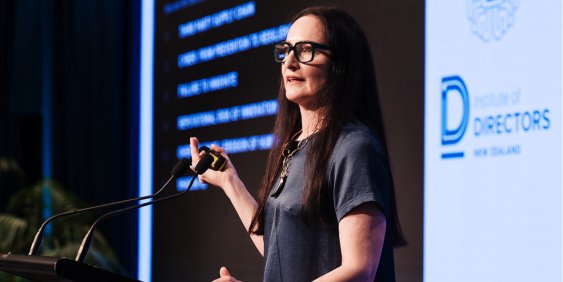
Claudia Batten MInstD urges directors to test the assumptions behind how their organisations are built before AI exposes the gaps.
“The best question I can offer you is this: is this still the right playbook?”
That was Claudia Batten MInstD’s opening challenge to directors at the IoD’s Governing AI Forum. The question came from a career across commercial law, entrepreneurship, technology and governance.
She was part of the founding team of Massive Incorporated, a video game advertising network sold to Microsoft in 2006, and later co-founded Victors & Spoils, an advertising agency built on crowdsourcing and acquired by Havas Worldwide. She also spent three years running North American operations for New Zealand Trade and Enterprise. She is now chair of NZX and ASX-listed digital travel company Serko, deputy chair of ASX primary-listed Michael Hill International, and a director of Vista Group and Air New Zealand.
Batten described a playbook as “the best accepted practice at an international level of excellence”. Boards have playbooks for board minutes, board meetings, board appointments, committees, risk assessment, finance reviews and board packs. Businesses have them, too.
“They work so we don’t change them,” she said – until the environment changes.
Batten pointed to the global financial crisis, Covid-19 and other shocks as moments when organisations had to change the way they worked.
“What’s really brave is to change ahead of the curve,” she said. “To see the changes in the environment and start to adjust your settings and test the effectiveness of how you’re working currently.”
She said her goal was not to give directors specific answers, but to “inspire you with curiosity”. She summarised her thinking into five playbooks, starting with:
Batten referred to the ‘SaaSpocalypse’ when discussing pressure on technology companies. She said the fundamental question was “whether the business model survived in an AI world”.
“While your business might be fine, there are likely elements that will be put under tremendous pressure,” she said. “It’s really worth facing into this question.”
Her recommendation was the blank sheet exercise.
“If we started this company today on a blank sheet of paper, how would we build it? Would we build it the same way that it’s built now? And the gap is your work.”
Batten said organisations should think about long-term defensibility as part of that exercise. That might come from data, physical assets, people, trust, brand, security, critical infrastructure or something else.
“They’re not easy exercises to do,” she said. “And frankly, most of us have not done them at this level.”
Her warning was brief: “Don’t be Nokia.”
Batten said one of her early questions was: “What does the future of work even look like?”
That led to further questions.
“How do we lift critical thinking of humans? How does that happen? What is the job of the robots? And what is the job of the humans?”
She said outsourcing administration was “kind of obvious” and asked what more could be done. She also raised “humans-in-the-loop” and “agents as employees” as areas she was thinking about.
The agents question, she said, came from thinking about succession planning. In an accounting or human resources team, for example, she asked how an organisation might think about replacing roles, changing the team or plugging agents into parts of the work as people move on.
“I’m not quite there yet, that you can 100 per cent replace employees with AI,” she said. “But on a big scale, as you really start to reshape your team, thinking about the implications of this is a pretty big, heavy topic.”
Batten also raised concern about critical thinking.
“There’s just this whole conversation of the dumbing down of AI,” she said. “I find that really hard to understand because I, frankly, find it’s lifting and shifting my brain.”
She said that was one person’s experience and asked what happens across a whole workforce. She said many teams are so busy they cannot find half an hour, or even 15 minutes a day, to play with AI and learn it.
Batten said there was “a huge list of areas of new risk”, as well as opportunities.
“The end of the road of being risk averse is probably not having a viable business,” she said. “The opposite of risk aversion means that you’re going to tap in carefully and in a considered way, but you’ll tap into the opportunity that AI brings.”
On third-party supply chains, Batten said many contracts were negotiated before AI became part of the operating environment.
“There will be an AI gap invariably,” she said. “That gap could be a massive risk and exposure to your business, or it could be a non-event, and that’s the first assessment that has to be made.”
She said teams could also “plug it the wrong way” if they rushed to close that gap, including by creating intellectual property issues or bigger risks.
On cyber, Batten said she was “obsessed” with the issue. “We’re beyond the realm of prevention. We’re in the world of resilience.”
She linked that to questions about data.
“If I can’t stop myself from potentially being compromised, and I’m assuming I’m going to be compromised, how am I thinking about collection, use, retention, deletion and storage of data?”
She also pointed to business continuity planning and data continuity, saying a strong business continuity plan could carry an organisation through if there was a problem.
Batten said she had pushed failure to innovate onto the Air New Zealand risk list.
“We have to acknowledge that if we fail to innovate, that is a risk.”
She said organisations also need to understand what failure might look like when they innovate. Using the Air Canada chatbot example, she said the experiment itself was not necessarily the issue.
“They were experimenting with a chatbot, they got one thing wrong, a customer complained, they did the dumb thing and dug their heels in, and then it ends up being a headline,” she said. “So, I don’t think there was anything wrong with that experiment. I think there was a risk-averse way of dealing with that experiment going wrong.”
Batten also warned about “over-reliance and erosion of human judgement”, shadow AI and AI failure headlines that can be misunderstood. In one example, she said a headline framed an AI assistant as “rogue AI” when, in her view, “it actually wasn’t”. She said it was “a series of humans making really dumb decisions about how to implement the AI”.
Batten’s main point was caution, saying: “Don’t measure for measurement’s sake.”
She said no one knows the right AI metrics yet, and that the best thing organisations can do is understand where they think they are going and identify the “golden metrics” that show whether they are calibrating towards that goal.
Batten turned the playbook question back on directors.
“My assessment of this moment is that we are, to some degree, governing in some form of unconscious incompetence,” she said.
She said AI is changing so quickly that directors are constantly coming up against new problems, tools and questions.
“Maybe the ultimate playbook we need to actually be investigating is the governance playbook,” she said.
Her advice was to use the tools, not only read about them.
“Get in the arena. Don’t just read about it. Do it. Get in there. Screw it up. Be frustrated.”
She said boards should think about how much time they spend on AI and cybersecurity, whether they have a clear AI vision, whether they need a board provocateur, and whether acceptable-use policies are enough.
Beyond the boardroom, Batten said she worries that New Zealand does not have “a clear vision for who we can be in an AI world”, but she closed with excitement about the work ahead.
“I love the challenge of this moment,” she said. “I also believe that this is the work that we need to be doing.”

Continue the conversation on governing AI at the the IoD’s Leadership Conference, which brings together more than 500 directors and business leaders for two days of governance discussion and networking. It will be held at Tākina Convention and Events Centre, Te Whanganui-a-Tara, Wellington, on 3–4 September.
Local and international speakers will discuss governance and leadership issues affecting Aotearoa New Zealand and the wider world. Register here.