Candour before the board decides
The CEO may experience each signal separately; the chair is often better placed to see how they connect.
Three experienced chairs on intervention, candour, disagreement and what they expect around the board table.
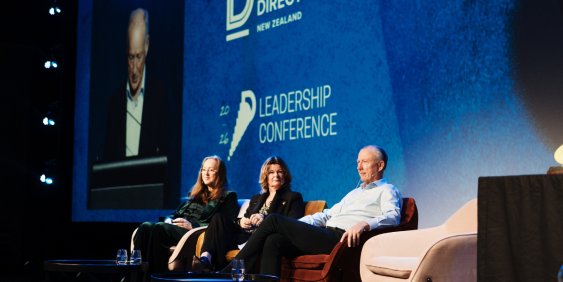
One of the breakout sessions at the IoD Leadership Conference brought together Scott St John CFInstD, Gráinne Trout CFInstD and Tania Simpson ONZM, CFInstD to discuss what separates good boards from great ones. Facilitated by IoD Chair Ross Buckley CFInstD, the session began with his questions to the panel before opening to the audience.
Buckley offered his own yardstick: oversight, insight, foresight – and a bit of hindsight.
He favours a boardroom mix of sector veterans, subject-matter experts and generalists with curiosity and different perspectives.
Simpson said having talented directors around the table was not enough. Boards should draw on the particular strengths of each director, including contributions outside formal meetings, without crossing into management’s responsibilities. Otherwise, valuable capability can remain “latent”.
For Trout, the exceptional directors she had worked with were those who consistently introduced a perspective nobody else had thought of – or nobody else had been willing to put on the table.
“They’ll summarise or bring in a different insight that totally changes the conversation,” she said.
St John compared a strong board with a sports team, where individual contributions combine to create a “one plus one makes three” effect.
Looking back over more than 11 years on one board, Trout identified only five or six decisions or moments when the board had added particular value.
Chief executive appointment and succession were foremost, alongside major capital allocation decisions and occasions when a culture reset was required.
“The best time to start a conversation about succession . . . is very early in the term, so that it’s just a natural part of how you talk about the business,” she said.
Some contributions never appear in an annual report. “You don’t see the things that didn’t happen,” Trout said.
Boards may reject proposals in which management has invested considerable time and energy. That requires enough trust for management to bring issues forward early, while knowing its recommendations will still be challenged.
Trout described management bringing a well-developed proposal to publicly front-foot a sensitive commercial issue.
The argument was strong, the board’s concern was timing.
“Now it’s not the right time,” she recalled the board concluding. Going public then would have put the company “in a line of fire”.
The work remained useful and could be drawn on later. The board’s contribution was recognising that a sound argument did not automatically make immediate action the right decision.
St John recalled joining Fonterra’s board about a decade ago and being surprised by the complexity of the organisation. At the core of some well-documented issues, he said, was a risk appetite that “was perhaps not as well formed as it might have been”, alongside interconnected risks that were not fully appreciated. The board intervened in several ways. A decade later, he said, it was pleasing to see the company “hitting runs”.
Simpson said boards can also bring a wider perspective when management overestimates the strength of stakeholder relationships, particularly with iwi. St John said Mercury had recognised it was “a little bit out of position” in some of its relationships with Māori partners. For about a year, each board meeting included a briefing on individual partners, building institutional knowledge that would remain as directors changed.
Later in the discussion, St John added a caution. Directors should resist the temptation to fix management’s problems themselves. If decision-making is effectively “delegated up” to the board, accountability between board and management begins to blur.
Asked about the chair-chief executive relationship, Trout’s first answer was one word: “Transparency.”
Simpson added regular, close communication. St John said nothing important should be left unsaid, even if the conversation happened before the formal meeting.
Trout recalled an executive saying that presenting to the board each month felt like facing a monthly panel interview. Someone who felt that way was unlikely to be open and transparent.
She also warned about the effect of an executive being “monstered” over an error. Previous experience of an aggressive response could make management more guarded the next time difficult news needed to be raised.
Simpson pointed to the power imbalance between directors and management. Boards needed to recognise it if they wanted people to speak freely.
Trout said boards should also examine their own decisions and ask what they could have done differently.
Simpson said changing economies, geopolitical instability and technological disruption were producing a wider range of possible outcomes and less time to respond.
She wants younger and more technically fluent people reaching the board table sooner, alongside experienced governors who can pass on what they have learnt.
She also stressed the need to hear and respect different perspectives around the table. “There’s no place for ego in the boardroom,” Simpson said.
St John pointed to ANZ New Zealand’s move away from a board historically composed largely of senior company chairs, bringing in directors with deep digital knowledge earlier in their governance careers.
Buckley cautioned against appointing someone for technology or AI expertise alone: what else could they bring to the table? St John agreed that subject-matter experts needed to contribute more broadly across the board’s work.
Where a sought-after executive lacked the time or governance experience for a directorship, Trout suggested an advisory role or committee appointment could provide access to that expertise.
The discussion identified several behaviours that might be accepted on a competent board but hold back a great one: questioning so blunt that management shuts down, board papers that remain merely adequate, directors taking excessive airtime and people speaking because they feel obliged to comment on every resolution.
Simpson said unnecessary airtime from one director leaves less room for others.
Buckley recalled a board where the chair had once asked every director to comment on every resolution. The practice was dropped. Directors spoke when they had something to add rather than because everybody was expected to take a turn.
Trout also noted that better board papers sometimes required management to be given enough people, time and resources to produce them.
St John recalled Barack Obama explaining that, before making a major decision, he wanted to hear the contrarian view whether he ultimately agreed with it.
St John saw a similar responsibility for chairs: hear the relevant perspectives, then have everyone leave the room owning the decision collectively.
Trout distinguished disagreement from conflict. A director might have chosen another course but could still support the board’s decision once their position had been heard.
Trout said she would address problematic behaviour through board reviews or directly with a director.
“I know you’re passionate about it, but you did come across as quite aggressive, and it shut down the management team,” she said.
Simpson said, as a natural introvert, she has sometimes had to work deliberately to make sure a different perspective is heard – occasionally by simply putting her hand up when discussion is moving on.
The final audience question asked what directors should do when they believed the chief executive was no longer right for the organisation but the chair was protective of them.
Trout’s immediate warning sign was “defensiveness”.
St John added that issues not being escalated quickly enough could be another signal.
Simpson acknowledged that a close chair-chief executive relationship could make a chair protective, but the chair remained one member of the board.
If a difficult conversation or decision was required, the other directors could not leave responsibility for it with the chair.