IoD backs international alignment on climate reporting
The IoD supports a shift to international climate reporting standards, with a shorter transition and practical guidance for boards.

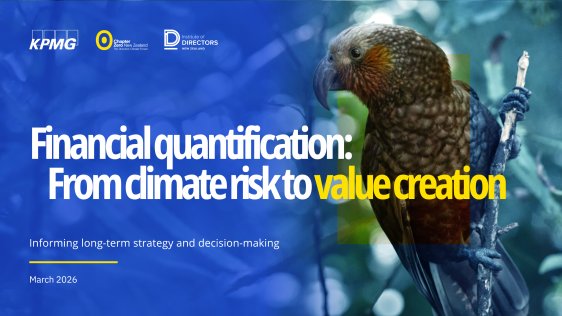
Connecting climate and nature-related risks and opportunities to your organisation’s long-term value.
Boards are increasingly navigating decisions in an environment shaped by climate risk, insurance constraints, capital pressures and supply chain volatility. These forces can influence financial performance, asset values and long-term viability – whether or not an organisation is required to disclose them. In this context, understanding potential financial impacts becomes is a core part of effective governance.
This guide is designed for directors and senior leaders who want to use financial quantification as a practical governance tool to support board decision-making. It supports helps boards to explore how a combination of physical, transition and market changes could affect their financial position, cash flows and long-term viability, and how that insight should inform strategy, risk management and investment decisions.
Financial quantification does not need to be perfect to be useful. When approached thoughtfully, it helps boards test assumptions, assess trade-offs and prioritise action in conditions of uncertainty. The objective is not to produce precise forecasts, but to generate decision-useful insight that strengthens oversight and long-term planning.
Produced by Chapter Zero New Zealand in collaboration with KPMG, this resource provides a structured approach to connecting climate-related impacts with enterprise value and board-level decision-making, reflecting recent work by the New Zealand Society of Actuaries on anticipated financial impacts.
Key highlights include:
Whether you are navigating disclosure requirements, responding to investor expectations, or simply strengthening resilience, this guide will help your board understand how climate-related impacts intersect with financial performance and how to govern accordingly.